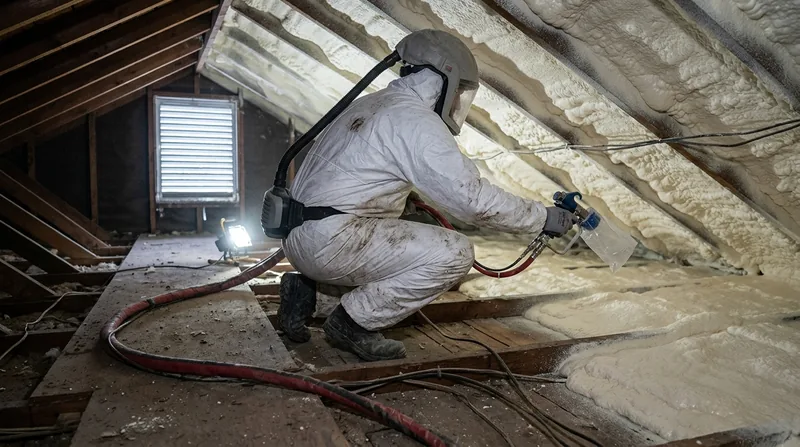




Attic spray foam insulation in Green Bay stops the heat loss that melts roof snow all winter and builds ice dams at the eaves. Green Bay's long heating season and early-1900s homes packed along the Fox River, postwar ranches in Allouez and Ashwaubenon, and newer subdivisions in Howard and Bellevue all share the same problem: warm indoor air rises into the attic, escapes through a leaky ceiling, and melts the snow sitting on the roof from below. That meltwater refreezes at the cold eaves and builds up ice that backs water into the house. Spray foam across the attic floor or sealed to the roof deck stops that heat loss, cuts your heating load all winter, and helps prevent the ice dam cycle that costs thousands in water damage and roof repair. We spray foam attics across Greater Green Bay, from Ashwaubenon to Howard, and help homeowners understand whether foam is the right answer for their home or whether a simpler upgrade will do the job.
Why Attic Heat Loss Matters in Green Bay's Cold Climate
IECC climate zone 6A winters are long and bitter. Your attic is often the warmest room in the house in January, and that heat is bleeding straight out through your ceiling into a vented attic space that sits at outdoor temperature. The warm air carries moisture with it, and where it meets the cold attic sheathing, that moisture condenses and soaks into insulation, rotting it and dropping its R-value to zero. At the same time, the heat melting your roof snow from below is the single largest driver of ice dams in Green Bay and the surrounding towns.
- Heat loss through an attic ceiling is the biggest energy waste in most Green Bay homes, accounting for 15 to 25 percent of total heating load.
- Ice dams form when attic heat melts snow on the roof, meltwater runs to the cold eaves, and refreezes into a dam that backs water into the house.
- Spray foam seals the attic boundary, stops that heat loss, and removes the heat source driving ice dam formation.
- Sealed attics also stop the stack effect that pulls cold air up through rim joists and basement walls, a secondary but significant heat loss path in older homes.
Stopping attic heat loss is the single most cost-effective energy upgrade in a Green Bay home, and it is the upgrade that also prevents water damage.
Key info: Ice dams are a symptom of attic heat loss, not a roof problem. Fixing the roof without sealing the attic means ice dams come back next winter. Spray foam across the attic floor or roof deck removes the heat source and stops the cycle. See the air sealing page for details on sealing the rim joist and band joist, the other major heat loss path in Green Bay homes.
How We Spray Foam Your Attic in Green Bay
Attic spray foam work starts with a full inspection and a written estimate that names the R-value you are buying, the thickness of the foam, and the method we will use. We do not give estimates over the phone, and we do not quote a price without seeing the attic. Every attic is different, and the right approach depends on what is already there, whether the attic is vented or can be sealed, and what your heating and moisture goals are.
- We inspect your attic, measure the existing insulation, check for moisture or mold, and identify all air leaks around penetrations, rim joists, and eaves.
- We write an estimate that specifies R-value, thickness per pass, foam type (closed cell or open cell), and the total board feet we will spray.
- We set up mechanical ventilation during the spray and cure process, controlling fumes and ensuring safe re-entry after 24 to 48 hours.
- We spray in controlled passes, matching the manufacturer ratio and drum temperature, and we install thermal and ignition barriers as required by code at your address.
- We clean up all equipment and debris, and we provide a warranty on our workmanship for one year from the completion date.
The entire process, from estimate to final inspection, is transparent and follows the building code that applies at your address.
Example: A 1,500-square-foot attic in Allouez with flat, settled fiberglass insulation at R-19 and air leaks around the rim joist and roof penetrations gets sealed with 2 inches of closed cell spray foam (R-12 per inch) across the roof deck, plus closed cell spray foam around all rim joist penetrations. Total cost is typically in the range of $2,200 to $3,100. The same attic in Howard with an open roof deck and no existing insulation would cost $1,800 to $2,400 for open cell foam at R-3.5 per inch, 6 inches thick, depending on access and the number of HVAC penetrations. See closed cell spray foam and open cell spray foam pages for the technical differences and when to use each.
Attic Spray Foam Methods: Sealed Roof Deck vs. Floor Insulation
| Approach | Description | Best For |
|---|---|---|
| Closed Cell Spray Foam, Sealed Roof Deck | 2 to 4 inches of closed cell foam sprayed directly to the underside of the roof sheathing, creating an unvented attic. Stops heat loss, stops condensation, and stops air movement entirely. R-value is 6 to 7 per inch. | Homes with existing vented attics where ice dams are a recurring problem, or where the attic space will be conditioned (finished as a room). Also the choice for metal buildings and barndominiums where condensation control is critical. |
| Open Cell Spray Foam, Sealed Roof Deck | 3 to 6 inches of open cell foam sprayed to the roof sheathing. Lower cost than closed cell, lower R-value per inch (R-3.5), but still stops heat loss and allows the attic to dry if moisture enters. Requires a vapor retarder on the interior side. | Budget-conscious attic sealing where condensation risk is low, or where the homeowner wants the attic to remain slightly permeable. Also used for sound dampening in upper floors. |
| Closed Cell Spray Foam, Attic Floor | 2 to 3 inches of closed cell foam sprayed across the attic floor (ceiling joists) on top of or replacing existing insulation. Leaves the attic vented and does not change the ventilation path. R-value is 12 to 21 depending on thickness. | Homes where the attic must remain vented by code or by HOA rule, or where roof deck access is limited. Adds R-value on top of existing insulation without disturbing the roof structure. |
| Open Cell Spray Foam, Attic Floor | 4 to 8 inches of open cell foam sprayed across the attic floor. Cheaper than closed cell, permeable, and allows the attic to breathe. R-value is 14 to 28 depending on thickness. Often used as a top-up over existing insulation. | Vented attics where existing insulation has settled or is inadequate, and where the budget is tight. Also used in attics where the homeowner wants to maintain traditional vented design. |
Sealed roof decks stop ice dams and heat loss more reliably than floor insulation alone, but they require more careful installation and code compliance. Floor insulation is simpler and cheaper, and it works well when the existing attic ventilation is sound. We assess your attic and recommend the method that fits your home, your budget, and the code that applies at your address.
Attic Spray Foam Insulation Cost in Green Bay: What to Expect
Attic spray foam pricing in Green Bay starts at $1.50 per square foot for open cell foam on the attic floor, and runs to $3.50 to $4.50 per square foot for closed cell foam on a sealed roof deck. The difference reflects the material cost, the labor required, and the complexity of the installation. A 1,500-square-foot attic with open cell floor foam runs $2,250 to $3,000. The same attic with closed cell roof deck sealing runs $4,500 to $6,000 or more, depending on the number of roof penetrations, the slope of the roof, and whether existing insulation must be removed first.
The main factors that move the price up or down are:
- Attic size and shape: a 1,200-square-foot ranch attic costs less than a 2,400-square-foot colonial with multiple roof slopes and dormers.
- Existing insulation: if old fiberglass or blown-in cellulose must be removed before foam is sprayed, removal adds $0.50 to $1.00 per square foot and takes a full day.
- Roof penetrations: HVAC ducts, flues, vent pipes, and electrical chases all need individual sealing and add labor and material cost.
- Access: if the attic is cramped, has low headroom, or requires special equipment to reach the roof deck safely, labor time increases.
- Foam type and thickness: closed cell is more expensive than open cell, and thicker foam costs more. Your R-value target and the existing insulation determine the thickness needed.
We always provide a written estimate with the square footage, the R-value, the thickness per pass, the foam type, and the total board feet. The estimate is free and carries no obligation. Call (920) 247-2669 to schedule one, or visit our pricing page for more detail on what moves the cost.
Getting two or three estimates from different contractors is smart. A low estimate with no R-value, no thickness specification, and a price far below market is often a sign of poor installation or shortcuts during cure. A good estimate names everything and explains why it costs what it does.
Attic Spray Foam Insulation Near Me: What to Look for When Hiring in Green Bay
Spray foam installation is not a licensed trade in Wisconsin, but it is highly technical work that goes wrong in predictable ways. A bad installer will spray too fast, skip mechanical ventilation during cure, promise immediate re-entry, quote a price with no R-value or thickness specification, and disappear if the smell does not go away after 48 hours. A good installer will slow down, ventilate the space, give you a written estimate with technical specs, and be reachable if you have questions after the job is done. Here is what to verify before you hire anyone, including us.
- Ask for proof of insurance and verify the coverage with the insurance company directly, not just by looking at a certificate.
- Request a written estimate that names the R-value, the thickness per pass, the foam type (closed cell or open cell), and the total board feet you are paying for.
- Ask how the contractor will ventilate the space during spray and cure, and what the re-entry window is (24 to 48 hours is standard).
- Check whether permits are required at your address by calling your local building department, and ask the contractor how they will handle permitting and inspection.
- Ask for references from recent jobs in Green Bay, Ashwaubenon, Allouez, or nearby towns, and call them to ask about the smell, the timeline, and whether the contractor was reachable after the job.
- If you have an HOA, check whether the HOA has rules about attic work or exterior equipment staging, and verify that the contractor can work within those rules.
Spray foam is a good product when it is installed right, and a source of regret when it is not. A contractor who takes time, follows the process, and stands behind the work is worth the price. Get a free estimate from us at our contact page, and compare it to at least one other contractor before you decide.
Attic Spray Foam Insulation in Green Bay: Pricing Guide
| Service | Price | Details |
|---|---|---|
| Open Cell Spray Foam, Attic Floor | Starting at $1.50/sq ft | 4 to 8 inches sprayed across ceiling joists, R-14 to R-28. Cost varies by thickness needed and existing insulation to work around or remove |
| Closed Cell Spray Foam, Attic Floor | Starting at $2.50/sq ft | 2 to 3 inches on ceiling joists, R-12 to R-21. Higher cost reflects denser material and better moisture and air barrier performance |
| Closed Cell Spray Foam, Sealed Roof Deck | Starting at $3.00/sq ft | 2 to 4 inches to underside of roof sheathing, R-12 to R-28. Stops ice dams and heat loss. Cost rises with roof complexity, penetrations, and removal needs |
| Insulation Removal (Fiberglass or Cellulose) | Starting at $0.50/sq ft | Removal and disposal of existing insulation before spray foam. Added to foam cost when attic is cluttered or contaminated |
| Free Estimate | No charge | Written spec with R-value, thickness, board feet, and total price. Response within 24 hours at (920) 247-2669 |
Indicative pricing, the exact cost depends on square footage, finish, and site access. Free personalized estimate within 24h at (920) 247-2669.


