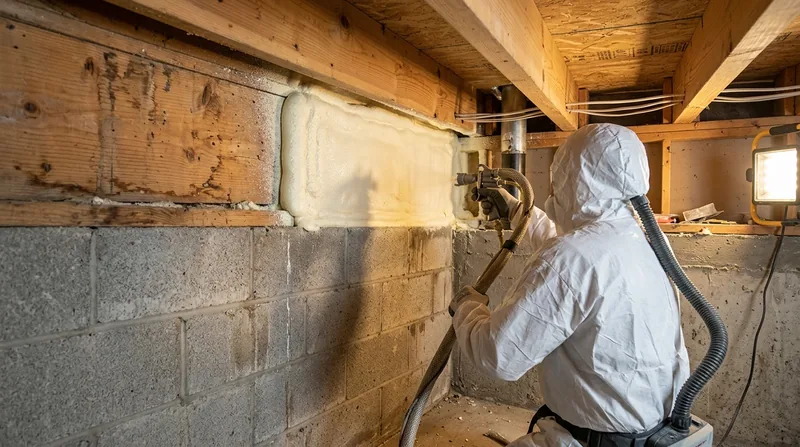




Closed cell spray foam insulation in Green Bay creates a rigid air barrier that stands up to the region's brutal winters and the moisture challenges that come with them. Green Bay sits in IECC climate zone 6A, where the heating season is long, intense, and unforgiving. Warm indoor air pushes outward through walls and ceilings all winter, and when it meets cold surfaces in basements, rim joists, and attics, condensation forms. Older homes near downtown and the Fox River often have balloon-framed walls with open stud bays that were never insulated, while postwar ranches in Allouez and Ashwaubenon carry shallow attic insulation that has settled flat over decades. Closed cell foam stops that heat loss and resists moisture where it matters most. We help homeowners and builders across Green Bay, Ashwaubenon, Howard, Bellevue, De Pere, and surrounding areas seal the leaks that drive heating bills up and indoor comfort down.
Why Closed Cell Spray Foam Matters in Green Bay's Cold Climate
Green Bay winters demand insulation that does more than just slow heat loss. The region's full basements and rim joists are the coldest, leakiest parts of most homes, and they sit directly above the ground where moisture is always a threat. Closed cell foam adds structural rigidity and moisture resistance that open cell cannot match. In early-1900s homes packed along downtown and near the river, where walls were never designed to hold insulation, closed cell retrofits seal stud cavities without requiring demolition. In newer construction across Howard and Bellevue, closed cell at the rim joist and top plate stops the stack effect that drives warm air out and cold air in all season long.
- Closed cell foam resists moisture where humid indoor air meets cold rim joists and basement walls in winter.
- The rigid foam adds structural strength to rim joists and band joists, which bear live load in older homes.
- Closed cell holds its R-value even when exposed to moisture, unlike fiberglass or cellulose.
- The air seal stops infiltration at the source, which is more effective than adding insulation alone.
- Closed cell is the standard for metal buildings and barndominiums in the region, where condensation on steel is the failure mode.
In Green Bay's heating-dominated climate, the biggest energy waste happens at the top and bottom of the house. Closed cell stops both.
Key info: A full basement rim joist in Allouez or Ashwaubenon that is still open to the rim band lets warm air escape and cold air creep in all winter. Closed cell foam at the rim joist, combined with air sealing at the top plate, cuts that stack-driven loss dramatically and is the entry point for most retrofit jobs in the area.
For more on how air sealing works hand-in-hand with insulation, see our air sealing service page.
How We Install Closed Cell Spray Foam Insulation in Green Bay
Closed cell spray foam is applied in controlled passes, building thickness layer by layer. The process requires precision: the drum temperature, the spray ratio, and the thickness per pass are all critical to performance and safety. We use mechanical ventilation during application and cure, and we follow a re-entry window of 24 to 48 hours before the space is occupied. The substrate must be dry and sound; if we find moisture, active leaks, or contamination, we address that first or we walk away. The foam cures to a rigid solid that bonds to wood, metal, concrete, and existing insulation, sealing air leaks at the same time it insulates.
- We inspect the space and identify any moisture, air leaks, or structural damage before spraying.
- We mask and protect areas that should not receive foam, including electrical outlets and HVAC vents.
- We spray closed cell in controlled passes, building to the specified thickness and R-value.
- We use mechanical ventilation throughout application and cure to manage VOCs and ensure safety.
- We provide a re-entry window of 24 to 48 hours and clear guidance on when the space is ready for occupancy.
The result is a continuous air barrier and insulation layer that works year-round against Green Bay's heating load.
Local example: A De Pere homeowner with a 1970s ranch and a shallow, settled attic insulation discovered ice dams forming every winter. We removed the old fiberglass, sealed the rim joist and top plate with closed cell, and sprayed the attic to R-38. The ice dams stopped because warm interior air no longer escapes into the cold attic space. The job took two days and included a full written estimate with R-value and thickness specifications before work began.
Learn more about how we handle attic insulation at attic spray foam insulation.
Closed Cell Spray Foam Methods and Applications
| Application | Description | Best for |
|---|---|---|
| Rim and Band Joist Sealing | Closed cell foam sprayed into the rim joist cavity and band board, sealing the air gap between basement and rim band. | Older full basements in Allouez, Ashwaubenon, and downtown Green Bay where rim joists are exposed or partially insulated. |
| Sealed Attic (Unvented Roof Deck) | Closed cell foam sprayed to the underside of the roof deck, creating an unvented attic that eliminates the stack effect and ice dam risk. | Homes with cathedral ceilings, finished attics, or chronic ice dam problems in Howard, Bellevue, and Suamico. |
| Wall Cavity Injection | Closed cell foam injected into wall cavities of existing homes without removal of siding or drywall, sealing air leaks and adding insulation. | Pre-1980 balloon-frame homes near downtown Green Bay and the Fox River where open stud bays were never insulated. |
| Metal Building and Condensation Control | Closed cell foam sprayed to the underside of metal roof and walls, blocking condensation and providing thermal break on steel. | Barndominiums, pole barns, and agricultural buildings where steel condensation is the dominant failure mode. |
| Crawl Space Encapsulation Support | Closed cell foam sprayed to rim joists and band boards in crawl spaces to seal air leaks and resist moisture ingress from the soil. | Crawl spaces with exposed rim joists, moisture risk, or ductwork that needs protection from ground humidity. |
Closed Cell Spray Foam Insulation Cost in Green Bay: What to Expect
Closed cell spray foam insulation starts at around $1.20 per board foot in the Green Bay area, though the final cost depends on several factors specific to your home and the job scope. The size of the space, the thickness and R-value required by code or design, access difficulty, substrate condition, and whether existing insulation must be removed all affect the price. A rim joist job in a finished basement costs less than sealing a full attic under a cathedral ceiling or spraying the underside of a metal roof. Getting 2 to 3 written estimates with R-value and thickness specifications is the smart move, because it lets you compare not just price but actual scope and performance.
- Rim joist and band joist sealing typically runs $1,200 to $2,500 for a full basement perimeter, depending on depth and linear footage.
- Sealed attic (roof deck) insulation costs $3,000 to $8,000 or more, depending on attic size and desired R-value.
- Wall cavity injection in older homes runs $2,000 to $6,000 per section, depending on wall height and cavity depth.
- Metal building and barndominium projects are quoted per square foot of roof or wall area, typically $1.50 to $2.50 per square foot.
- Insulation removal, which often precedes a closed cell job, adds cost but is necessary for a proper retrofit.
See our full pricing overview for more detailed ranges and examples.
Cost drivers in Green Bay: A home in Allouez with a finished basement and exposed rim joist will have lower labor access than a home in Howard with a crawl space. An attic retrofit that includes insulation removal costs more than a top-up on sound insulation. A metal building with condensation damage may need substrate prep before foam can be applied. All of these factors move the price, which is why a written estimate on site is the only honest answer.
What to Look for When Hiring a Spray Foam Insulation Contractor Near Green Bay
Choosing a spray foam contractor is a decision that affects your home's comfort, energy bills, and safety for years to come. The trade includes local independents, national franchises, and rig-and-run crews that spray a job in an afternoon and disappear. You should verify that any contractor you hire is fully insured and carries liability coverage that covers spray foam work. Ask for references from recent jobs in your neighborhood, and call them to ask about the quality of the work, the professionalism of the crew, and whether any issues arose after the job was complete. Get written estimates from at least two contractors, and make sure each one specifies the R-value, thickness, and board-foot total so you can compare apples to apples.
- Ask whether the contractor is fully insured and request a certificate of insurance that covers spray foam application.
- Request references from jobs completed in Green Bay, Ashwaubenon, Allouez, or nearby in the last 12 months.
- Get a written estimate that includes R-value, thickness per pass, total board feet, and the re-entry window after cure.
- Understand who is responsible for permits and what local building department approval is required at your address.
- Ask about the mechanical ventilation plan during application and cure, and the timeline for the job.
- Verify that the contractor will walk away if moisture, active leaks, or contaminated substrate are found, rather than spray over it.
A contractor who can answer these questions clearly and provide references is one you can trust. Call us for a free estimate at (920) 247-2669, and we will walk you through the process and answer all your questions.
Closed Cell Spray Foam Insulation in Green Bay: Pricing Guide
| Service | Price | Details |
|---|---|---|
| Rim Joist and Band Joist Sealing | Starting at $1.20/board ft | Entry-level job that seals the coldest, leakiest part of most basements; price rises with depth and linear footage of rim exposure |
| Sealed Attic (Roof Deck Spray) | Starting at $1.20/board ft | Larger scope that eliminates ice dams and stack-driven heat loss; total cost depends on attic size, cathedral geometry, and desired R-value |
| Wall Cavity Injection (Retrofit) | Starting at $1.20/board ft | Seals open stud bays in pre-1980 homes without demolition; cost varies with wall height, cavity depth, and how many sections are treated |
| Metal Building and Condensation Control | $1.50 to $2.50/sq ft | Closed cell on steel roof and walls to block condensation and provide thermal break; larger buildings and difficult access can move cost upward |
| Insulation Removal and Replacement | On estimate | Precedes most retrofit jobs; scope depends on existing insulation type, volume, and whether hazmat testing or disposal is required |
| Free written estimate | No obligation | Response within 24 hours at (920) 247-2669; includes R-value, thickness, board-foot total, and timeline before any commitment |
Indicative pricing, the exact cost depends on square footage, finish, and site access. Free personalized estimate within 24h at (920) 247-2669.


