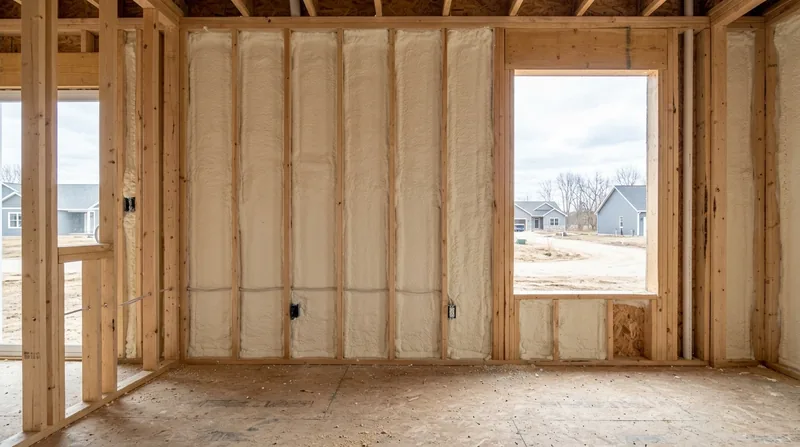




Commercial & New Construction Spray Foam in Green Bay is the air sealing work that happens before drywall goes up, and it is the difference between a tight, efficient building envelope and one that bleeds heat all winter. New construction in Howard, Bellevue, and Suamico moves fast, and the window to seal rim joists, top plates, and penetrations closes once framing is covered. We work with builders and general contractors across Brown County to spray foam the thermal boundary before the next trade arrives, stopping the stack effect that drives heating costs through the winter in this IECC zone 6A climate. Newer subdivisions spreading east toward the bay of Green Bay are built tighter than the postwar ranches in Allouez and Ashwaubenon, but they still need careful insulation at the rim and the top plate to stop warm indoor air from pushing outward and carrying heat away all season long. This is not a retrofit problem; this is a framing-stage problem, and it requires a spray foam crew that understands builder scheduling and can deliver a clean, code-compliant installation the day before drywall arrives.
Why Commercial & New Construction Spray Foam Matters in Green Bay
New construction in Brown County is moving outward from the river and downtown, and the tighter the building envelope, the higher the ROI on the insulation work. A sealed rim joist and a sprayed top plate stop the long northern Wisconsin heating season from draining energy through the frame before a single HVAC cycle runs. The problem is not unique to new construction, but the solution is: once drywall is hung, you cannot reach the rim joist or the top plate without tearing into the wall. Spray foam applied during the framing stage is permanent, invisible, and uncompromised by settling, moisture, or age.
- We seal rim joists and band joists before concrete floors or finished basements go in, stopping the coldest path for heat loss in the house.
- We spray top plates and header cavities to close the stack effect at the attic boundary, a critical air leak that fiberglass does not address.
- We seal around all penetrations, electrical, plumbing, HVAC, before the drywall crew covers them and locks in air leaks.
- We work on the builder's schedule, moving in and out the same day so the next trade is not delayed.
- We apply foam to the correct thickness and density for the use, documented in writing so the building inspector and the energy code are both satisfied.
A properly sealed thermal boundary in new construction costs less to heat all winter and performs exactly as the builder and the homeowner expect.
Key info: Spray foam applied during framing is the only way to seal the rim joist and the top plate air-tight. Fiberglass batts and blown-in insulation cannot reach these cavities, and once drywall is up, they are inaccessible without demolition. New construction in Bellevue and Howard moves fast, and the framing window is short; we schedule around the builder's timeline.
For more on how spray foam seals the thermal boundary, see our page on air sealing in Green Bay.
How We Work with Builders on Commercial & New Construction Projects in Green Bay
We coordinate with the general contractor and the project schedule from the first conversation. Once the framing is weather-tight and the rough-in trades are clear, we move in, spray the rim, the top plate, and all penetrations, and move out the same day. The process is fast, clean, and documented so the building inspector has everything needed to sign off. We provide a written estimate with R-value, thickness, and board-foot coverage so the builder knows exactly what is being installed and why.
- We schedule the spray date around the builder's framing and rough-in timeline so no trade is held up.
- We inspect the substrate before spraying, and we walk away if the rim or the top plate is wet or contaminated.
- We apply the correct foam type for the use, closed cell for rim joists and sealed cavities, open cell or closed cell for top plates depending on the climate and the building design.
- We provide mechanical ventilation during cure and a re-entry window of twenty-four to forty-eight hours so the next trade can move in safely.
- We deliver a written scope with R-value, thickness, and board-foot count so the building official and the energy code audit have a clear record.
The result is an air-sealed, thermally efficient building envelope that costs less to heat and performs as designed.
Example: A new residential subdivision in Howard with 12 homes on a 6-week framing schedule. We coordinate with the GC to spray the rim and top plate on each home the day after rough-in electrical is complete, so the drywall crew moves in the next morning. Each home takes 4 to 6 hours, and we complete the entire phase in two weeks, well ahead of the final inspection.
For details on how we handle rim joist and band joist spray foam, see our dedicated service page.
Commercial & New Construction Spray Foam Methods and Applications
| Approach | Description | Best for |
|---|---|---|
| Closed Cell Rim Joist Spray | High-density foam applied to the rim cavity and rim board, R-6 to R-7 per inch, stops air and vapor movement completely. | Rim joists in basements and crawl spaces, the coldest and most critical air leak in new construction. |
| Closed Cell Top Plate Seal | Low-pressure closed cell applied in a thin band around the top plate and into the attic boundary, sealing the stack effect at the frame. | Two-story homes and any new construction where the attic is sealed or vented; stops warm air from bypassing the attic insulation. |
| Open Cell Wall Cavity Fill | Low-density foam sprayed into stud cavities before drywall, R-3.5 per inch, allows vapor transmission and reduces sound transmission. | Exterior walls in new construction where vapor management is required and the wall will be vented or drained. |
| Penetration and Header Sealing | Closed cell foam applied around electrical chases, plumbing stacks, and HVAC ducts, and in header cavities above doors and windows. | Every new construction project; seals the small air leaks that add up to significant heat loss if left open. |
Each application is chosen based on the building code, the climate zone, the builder's energy goals, and the specific use of the space. We document the foam type, density, thickness, and board-foot coverage in writing so the building inspector and the energy code audit have a complete record.
Commercial & New Construction Spray Foam Cost in Green Bay: What to Expect
The cost of spray foam insulation on a new construction project depends on the scope of the work, the foam type, the size of the building, and the complexity of the thermal boundary. A rim joist on a 2,000 square foot home costs less than sealing the rim, top plate, and all penetrations on a 5,000 square foot commercial shell. We provide a free commercial estimate on site, with R-value, thickness, and board-foot coverage spelled out in writing so you know exactly what you are paying for and why.
Factors that affect the cost include the linear feet of rim joist, the number of stories, the complexity of the framing (standard stud cavities versus headers and penetrations), access to the rim (crawl space, basement, or slab), and whether the top plate and attic boundary need sealing. A builder working on multiple homes in a single subdivision often qualifies for a volume discount, because we can schedule the work efficiently and move from one site to the next without mobilization delays.
The best way to understand the cost for your project is to contact us for a free estimate. We will walk through the scope, explain the foam type and thickness, answer questions about the building code and the energy standard, and give you a written price with no obligation to proceed. Most new construction projects in Howard, Bellevue, and Suamico are completed within the builder's framing schedule, so there is no delay and no surprise cost.
For a detailed breakdown of pricing across all our services, see our pricing page.
What to Look for When Hiring a Spray Foam Insulation Contractor Near Me in Green Bay
Hiring the right spray foam contractor for new construction is about verifying insurance, understanding the scope, and checking references from other builders in the area. Spray foam is a regulated product, and the installation must meet the building code and the energy standard in force at your address. The contractor you hire should provide a written estimate with R-value and thickness, answer questions about the cure time and re-entry window, and carry insurance that covers the work and the liability if something goes wrong.
- Ask for proof of insurance and verify the coverage covers spray foam application and the liability limits you need.
- Request references from builders or GCs in Brown County who have used the contractor on new construction projects.
- Get a written estimate with R-value, thickness, and board-foot coverage, not just a price per square foot or a vague description.
- Understand the re-entry window and the cure time so the next trade can move in on schedule.
- Verify that the contractor is familiar with the building code and the energy standard in your municipality, because permit and inspection requirements vary from city to city across Greater Green Bay.
- Check that the contractor provides mechanical ventilation during cure and follows the manufacturer's specifications for temperature, ratio, and application pressure.
A contractor who walks you through the scope, answers your questions directly, and provides a complete written estimate is the one who is likely to deliver a clean, code-compliant installation on schedule.
If you are in Green Bay, Ashwaubenon, Allouez, Bellevue, De Pere, Howard, Suamico, or any other municipality in Brown County, contact us today for a free estimate and to discuss your new construction project. We are fully insured and carry written estimates with R-value and thickness specifications.
Commercial & New Construction Spray Foam in Green Bay: Pricing Guide
| Service | Price | Details |
|---|---|---|
| Rim Joist Spray (per linear foot) | Starting at $15-$25 | Closed cell foam from rim board to rim cavity, typical 2 inch depth, includes labor and material |
| Top Plate and Attic Boundary Seal | Starting at $8-$12 per linear foot | Closed cell applied around top plate perimeter, typical 1 to 2 inch band, includes labor and material |
| Wall Cavity Fill (per board foot) | Starting at $0.65-$0.95 | Open cell or closed cell in stud cavities, includes labor, material, and mechanical ventilation during cure |
| Free Commercial Estimate | Free | On-site measurement, R-value and thickness specifications, written scope, no obligation to book |
| Travel and Scheduling | Included | No separate mileage fee for Green Bay and surrounding Brown County municipalities, coordination with builder schedule |
Indicative pricing, the exact cost depends on square footage, finish, and site access. Free personalized estimate within 24h at (920) 247-2669.


