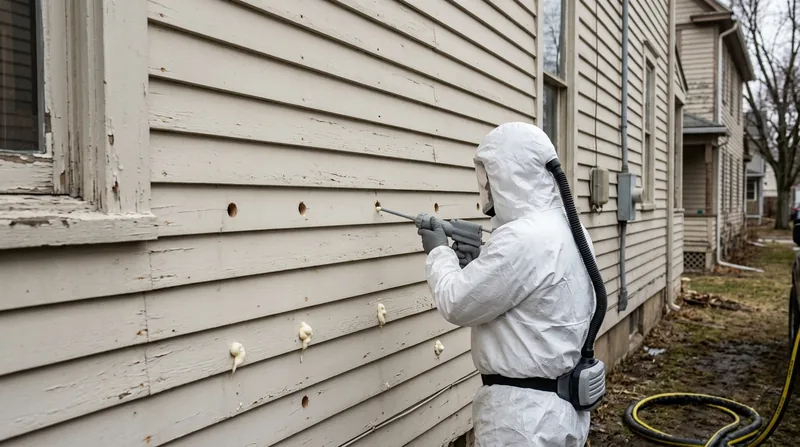




Wall and injection foam insulation in Green Bay fills the closed cavities of older homes without opening the drywall, restoring insulation to walls that were built before fiberglass became standard. Brown County's housing stock runs from early-1900s balloon-framed homes packed along the Fox River and downtown Green Bay to postwar ranches spreading through Allouez and Ashwaubenon. Many of those older homes, especially near the river, have stud cavities that were never insulated when they were built, or insulation that has settled and failed over eighty or ninety years. Wall injection foam reaches into those cavities through small holes drilled from the outside, fills them completely, and seals air leaks that fiberglass batts would never close. In a climate zone 6A heating season as long and cold as ours, stopping that heat loss through the walls makes a real difference in winter comfort and heating costs. We help homeowners in Green Bay, Ashwaubenon, Allouez, De Pere, Howard and across Brown County restore the insulation performance their older homes need.
Why Wall Injection Foam Matters in Cold Green Bay Winters
Green Bay homes built before 1980, especially those with balloon framing near downtown and the Fox River, often have open or empty stud cavities that allow warm indoor air to escape directly to the outside. In our long heating season, that continuous air leakage drives up heating bills and creates cold spots along exterior walls that no amount of blankets can fix. Injection foam seals those cavities completely without disturbing the drywall or plaster on the inside, and without the cost and mess of tearing into the walls from the street side. The foam cures to a rigid or semi-rigid state depending on the type, and stays in place for the life of the house.
- Reaches cavities in balloon-framed walls that fiberglass batts cannot fill completely, sealing air leaks that cost you heat all winter.
- Requires only small holes drilled from outside, leaving interior walls and finishes intact and avoiding costly drywall repair.
- Sets up in hours and requires no interior access, making it ideal for homes where the interior finish is historic or valuable.
- Delivers an air seal and insulation value in a single application, stopping both conductive heat loss and air infiltration through the wall cavity.
Wall injection foam turns a liability of older Green Bay homes into a solved problem without renovation.
Key info: Homes built before 1950 in downtown Green Bay and along the Fox River corridor often have balloon framing, where vertical studs run the full height of the house without horizontal blocking between floors. This design leaves continuous cavities that act like chimneys for warm air to escape. Injection foam fills these cavities completely, stopping that stack effect and the heat loss that drives up winter heating bills.
For more on how air sealing works across your whole home, see our air sealing service page.
How Wall Injection Foam Installation Works in Green Bay
Wall injection foam starts with a site inspection to identify the wall cavities, confirm their depth and width, and locate any obstructions like fire blocking or existing insulation. We drill small holes (typically 1 to 1.5 inches) through the exterior siding or brick, spaced vertically to reach the full height of each cavity. Foam is injected under controlled pressure, filling the cavity from bottom to top, and the holes are patched with plugs or filled and caulked to match the exterior finish. The entire process is done from outside, and the home remains fully accessible during the work.
- We inspect the wall cavity with a borescope or thermal imaging to confirm its condition and depth before any drilling begins.
- Holes are drilled at the correct spacing and angle to reach the full height and width of the cavity without damaging studs or utilities.
- Foam is injected slowly and at the correct pressure to fill the cavity completely without over-pressurizing and bowing the walls.
- Holes are sealed with foam plugs, wood dowels, or caulk, and exterior finish is patched to match the original siding or brick.
- We verify fill density and coverage by checking the weight of injected foam and confirming cavity pressure before we finish.
The result is a wall cavity that is completely filled and sealed, with no voids, no settled insulation, and no air leakage.
Example: A 1920s home in Allouez with 2x4 balloon-framed walls and original brick exterior had cold walls and drafts all winter. Wall injection foam was drilled and injected into the cavities from outside, filling the 3.5-inch depth completely. Exterior brick was patched with mortar to match, and the homeowner saw a noticeable improvement in wall temperature and heating comfort within the first cold snap. Interior finishes, plaster walls, and trim were never touched.
See how wall injection complements rim joist and band joist sealing to stop heat loss at the top of the basement walls.
Wall Injection Foam Methods and Options
| Method | Description | Best For |
|---|---|---|
| Closed-Cell Injection Foam | High-density foam with R-value of 6 to 7 per inch, creates a vapor barrier, resists moisture and air leakage completely. | Older homes with moisture risk, walls exposed to weather, cavities where vapor control is critical. |
| Open-Cell Injection Foam | Lower-density foam with R-value of 3.5 to 4 per inch, breathable, allows drying, lighter and easier to inject into tight cavities. | Interior wall cavities in dry climates, walls with existing insulation that needs supplementing, sound dampening. |
| Two-Component Urethane Injection | Lower-pressure system, slower cure, allows longer working time and more precise fill control in deep or complex cavities. | Cavities with fire blocking or obstructions, homes where minimizing noise and disruption is important. |
| Blown-In Cellulose or Fiberglass (Alternative) | Loose-fill insulation, does not air seal, settles over time, lower cost but does not address air leakage. | Only when cavity access allows removal of exterior finish and re-installation, and air sealing is not the primary goal. |
For walls in older Green Bay homes, closed-cell injection foam is the standard because it seals completely, resists moisture from seasonal temperature swings, and holds its R-value without settling. Open-cell foam is lighter and easier to inject into tight cavities, but closed-cell delivers the vapor barrier and durability that cold-climate walls need.
Wall and Injection Foam Insulation Cost in Green Bay: What to Expect
Wall injection foam in Green Bay typically starts at $2 per square foot of wall cavity being filled, with most residential jobs falling in the $1.50 to $3.50 per square foot range depending on cavity depth, wall height, accessibility, and the type of foam selected. A typical exterior wall on a two-story home might be 300 to 500 square feet of cavity area, putting the cost between $450 and $1,750 for that wall. The final price depends on how many walls need filling, whether the exterior is siding or masonry (masonry drilling costs more), and whether existing insulation or obstructions require extra work to clear the cavity first.
The most important step is getting a written estimate with cavity dimensions and R-value specified. We measure the wall cavity on site, confirm the depth and width, identify any obstructions, and give you a firm price before any drilling starts. Comparing two or three estimates from different contractors is smart, but make sure each one specifies the R-value of the foam, the thickness per pass, and the total square footage of cavity being filled. A low-price estimate with no detail is a warning sign.
See our full pricing page for more detail on how we structure costs and what factors move the price up or down.
What to Look for When Hiring a Wall & Injection Foam Contractor Near Me in Green Bay
Hiring a spray foam contractor for wall injection is a big decision, and the difference between a careful, local installer and a fly-by-night rig is enormous. A good contractor will show up in person to inspect the walls, ask detailed questions about the home's history and any moisture issues, and give you a written estimate with cavity dimensions, foam type, and R-value clearly stated. They will explain the drilling process, show you how holes will be patched, and be reachable after the job if questions come up. A bad contractor will quote you a price over the phone with no site visit, promise to start work tomorrow, and be impossible to reach if the smell lingers or a hole is not patched properly.
- Verify that the contractor is fully insured and carries liability coverage that covers spray foam work, and ask to see a current certificate.
- Ask for at least two references from homes in Green Bay or nearby where wall injection was done, and call them to ask about the quality and the contractor's responsiveness.
- Get a written estimate that specifies the cavity depth and width, the foam type (closed-cell or open-cell), the R-value per inch, and the total cost with no hidden charges.
- Confirm that the contractor will handle permitting questions and defer to the local building department on any issues specific to your address.
- Ask about the ventilation plan during curing, the re-entry window, and any odor or off-gassing you should expect, and get that in writing.
The local independent contractor with a Green Bay address and a reputation in the community is your safest bet, because they are reachable, they know the local building code and permitting rules, and they have skin in the game if something goes wrong.
Call us at (920) 247-2669 or request a free estimate online and we will send someone to inspect your walls and give you a detailed, written quote with no obligation.
Wall & Injection Foam Insulation in Green Bay: Pricing Guide
| Service | Price | Details |
|---|---|---|
| Wall injection foam, closed-cell | Starting at $2/sq ft | Cavity depth, wall height, exterior finish type (siding vs. masonry), and accessibility determine final cost. |
| Wall injection foam, open-cell | Starting at $1.50/sq ft | Lower density than closed-cell, best for interior walls or supplemental fill, easier injection in tight cavities. |
| Exterior finish patching | Included | Holes are sealed with foam plugs, wood dowels, or caulk and finished to match original siding or brick. |
| Site inspection and written estimate | Free | We measure cavity dimensions, identify obstructions, and specify foam type and R-value before any work begins. |
| Travel and setup | Included | No separate mileage fee or travel charge in Green Bay and surrounding Brown County service areas. |
| Emergency or rush scheduling | On estimate | Same-day or next-day availability available on request, contact us at (920) 247-2669 for urgent jobs. |
Indicative pricing, the exact cost depends on square footage, finish, and site access. Free personalized estimate within 24h at (920) 247-2669.


