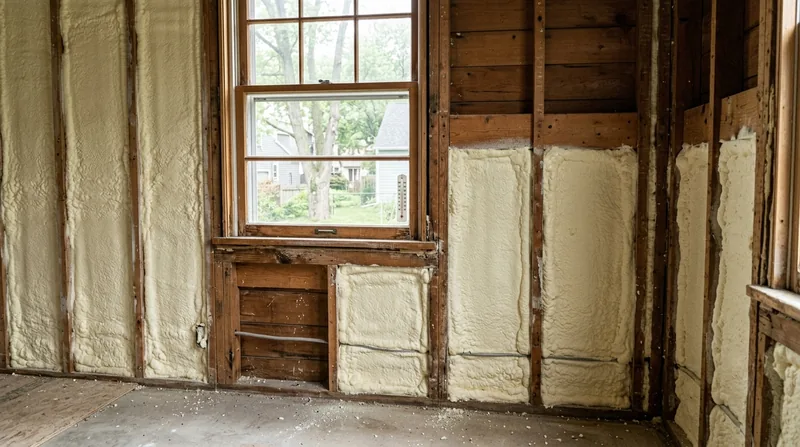




Open Cell Spray Foam Insulation in Green Bay fills irregular stud bays and partition walls in the older balloon-framed homes clustered along the Fox River and throughout Allouez, Ashwaubenon, and De Pere, where conventional fiberglass batts leave gaps and voids. In IECC climate zone 6A, where heating drives the energy bill all winter, every air leak and thermal bypass costs money month after month. Open cell foam expands to fill cavities completely, seals the penetrations that fiberglass misses, and dampens sound in interior walls and ceilings where moisture is not a concern. Unlike closed cell foam, open cell is softer, easier to cut and patch, and costs less per board foot, making it the right choice for interior applications and attic top-ups where moisture management is not the primary driver. We have been installing spray foam insulation across Greater Green Bay since 2010, and we know which product solves which problem. Learn more about our full range of spray foam services.
Why Open Cell Spray Foam Matters in Cold-Climate Green Bay Homes
Green Bay's long heating season and stack effect create relentless outward pressure on warm indoor air. That air seeks the path of least resistance, flowing up through attics and out through ceiling penetrations, electrical chases, and the gaps that fiberglass never sealed. In older homes near downtown and the river, balloon framing and open stud bays were never designed to hold insulation at all. In postwar ranches throughout Allouez and Ashwaubenon, shallow attic insulation has settled flat over decades, leaving the top plates and eaves exposed. Open cell foam expands to fill every void, seals those leaks, and stops the air movement that drives heat loss.
- Open cell foam expands to fill irregular cavities that fiberglass batts cannot reach, sealing the stud bays and penetrations that are the real culprits in winter heat loss.
- The foam creates an air barrier as it cures, stopping the stack effect that pushes warm air toward the cold attic and cold outside.
- In interior partitions and ceilings, open cell dampens sound transmission between rooms, a benefit closed cell cannot match at the same cost.
- Open cell is easier to cut, patch, and retrofit around existing wiring, plumbing, and ductwork without the mess and complexity of closed cell installation.
These factors combine to make open cell the practical answer for attic top-ups, interior wall fills, and retrofits of older Green Bay homes where the goal is to stop air leaks and improve comfort without the cost and density of closed cell.
Key info: In Green Bay's climate, the majority of winter heat loss happens at the top of the house and through rim joists. Open cell spray foam in the attic and at the top plates of older homes near the river and throughout Allouez stops that loss immediately. For rim joists and crawl spaces where moisture is a risk, closed cell spray foam is the better choice.
For more on permit requirements and code compliance in your city, consult the City of Green Bay Building Department or your local municipal office.
How We Install Open Cell Spray Foam Insulation in Green Bay
Open cell spray foam installation is a controlled process. We arrive on site with equipment calibrated to the manufacturer's drum temperature and mix ratio, set up mechanical ventilation to manage fumes during cure, and spray the foam in multiple thin passes rather than one thick pour. Each pass expands and sets before the next one goes down, ensuring uniform density and proper adhesion to the substrate. After the foam cures, typically within twenty-four to forty-eight hours, we trim the excess flush with the framing and install the required thermal barrier (typically 1/2-inch drywall in attics) to meet code. The result is a seamless air barrier that stops leaks and stays in place.
- We inspect the substrate for moisture, active leaks, or contamination and walk away if the conditions are not right for a lasting installation.
- We set up mechanical ventilation during the spray and cure process to manage off-gassing and ensure safe air quality in the home.
- We spray open cell in multiple thin passes, allowing each pass to expand and set, rather than one thick application that can sag, shrink, or cure unevenly.
- We trim the foam flush with the framing and install the required thermal barrier (typically 1/2-inch drywall in attics) before the job is complete and the home is re-occupied.
- We provide a written estimate with R-value, thickness, and board-foot quantity so you know exactly what you are paying for and what you are getting.
This methodical approach takes longer than a rig-and-run job, but it is the only way to ensure the foam stays put, performs as specified, and does not create odor or air quality issues after the crew leaves.
Local example: A 1950s ranch in Allouez with a vented attic and settled fiberglass typically needs 4 to 6 inches of open cell foam sprayed over the top plates and into the eaves to stop ice dams and heat loss. The job takes a full day, requires a twenty-four-hour re-entry window, and costs between $1,200 and $2,000 depending on attic size and access. A similar retrofit in a balloon-framed home near downtown Green Bay may cost more because of the complexity of filling open stud bays and the need to work around plaster and older wiring.
Learn more about how we approach attic spray foam insulation and the differences between attic and wall applications.
Open Cell vs. Closed Cell Spray Foam: Which is Right for Your Green Bay Home?
| Foam Type | R-Value per Inch | Best For | Cost Range |
|---|---|---|---|
| Open Cell | 3.5 to 3.8 | Attic top-ups, interior partitions, sound dampening, older homes with irregular cavities | From $0.55/board ft |
| Closed Cell | 6.0 to 6.5 | Rim joists, crawl spaces, metal buildings, high-moisture areas, sealed attics | From $1.00/board ft |
| Blown Fiberglass | 2.2 to 3.2 | Attic top-ups on sound existing insulation, budget-conscious retrofits | From $0.35/board ft |
| Fiberglass Batts | 3.2 to 3.8 | New construction, simple rectangular cavities, standard stud spacing | From $0.25/board ft |
Open cell foam is the middle ground. It costs less than closed cell, performs better than fiberglass in irregular cavities and around penetrations, and is the right choice for most attic retrofits in Green Bay's older housing stock. Closed cell is denser, more moisture-resistant, and required for rim joists, crawl spaces, and metal buildings where moisture or structural performance matters. On a simple top-up of a sound attic with no air leaks or penetrations, blown fiberglass is sometimes the right answer, and we will tell you so.
Open Cell Spray Foam Insulation Cost in Green Bay: What to Expect
Open cell spray foam in Green Bay typically costs from $0.55 per board foot, with the final price driven by attic size, foam thickness, substrate condition, and access. A 1,000-square-foot attic sprayed with 4 inches of open cell foam runs approximately 1,300 to 1,500 board feet, putting the material cost in the $700 to $800 range before labor, equipment, and the thermal barrier installation. Labor and setup typically add $600 to $1,200 depending on complexity, bringing a typical attic job to $1,300 to $2,000.
Factors that move the price up or down include the following.
- Attic size and foam thickness determine board-foot volume, the main cost driver for any spray foam job.
- Substrate condition matters: a dry, clean attic with no leaks or contamination costs less to prepare than one with moisture damage or old insulation to remove first.
- Access and layout affect setup time and labor: a simple rectangular attic with open framing is faster than a complex roof with many penetrations, valleys, or low eaves.
- Thermal barrier installation (drywall or intumescent paint) is required by code in attics and adds $200 to $400 to the total cost.
- Removal of old insulation is a separate service and is often necessary before new foam goes down, especially in postwar ranches where settled fiberglass covers the entire attic.
The best way to know your actual cost is to request a free estimate. We measure on site, specify R-value and thickness in writing, and quote the total before any work begins. No surprise charges, no per-foot adjustments after the job is done.
For a full breakdown of pricing across all our services, see the pricing overview.
What to Look for When Hiring a Spray Foam Contractor Near Green Bay
The spray foam trade has two extremes: rig-and-run crews that spray a job in an afternoon and disappear when the smell will not go away, and national franchises that charge premium prices and may not know the specifics of your city's permit requirements. A local independent contractor with a local address and local plates is positioned to give you honest guidance and be reachable if something goes wrong. Here is how to verify any spray foam installer, including us.
- Confirm that the contractor carries full liability and property damage insurance and can provide a certificate of insurance before work begins.
- Ask for a written estimate that specifies R-value per inch, foam thickness in inches, total board feet, and the cost per board foot so you can compare fairly across multiple bids.
- Verify that the contractor will set up mechanical ventilation during the spray and cure process and will specify a re-entry window of twenty-four to forty-eight hours before the home is occupied.
- Check with your local building department to confirm whether a permit is required for spray foam insulation at your address and whether the contractor will help you navigate the process.
- Ask for references from at least two recent jobs in Green Bay or the surrounding area and contact those homeowners to ask about odor, durability, and professionalism.
- Confirm that the contractor is fully insured and ask to see proof before signing any contract.
Permitting and thermal barrier requirements vary from city to city across Greater Green Bay. Green Bay, Allouez, Ashwaubenon, De Pere, Howard, and Bellevue each have their own building departments and codes. Do not assume a contractor licensed in one city is automatically compliant in another. Ask which city your home is in, and always defer to the local building official on what applies.
When you are ready to move forward, contact us for a free estimate. We are fully insured, provide written specifications, and have been serving Greater Green Bay since 2010. Call (920) 247-2669 or fill out the form on our contact page.
Open Cell Spray Foam Insulation in Green Bay: Pricing Guide
| Service | Price | Details |
|---|---|---|
| Open Cell Spray Foam (per board foot) | Starting at $0.55/board ft | Material cost for open cell foam; total board feet determined by attic size and desired R-value thickness |
| Typical attic retrofit (1,000 sq ft, 4 inches) | $1,300-$2,000 | Includes material, labor, mechanical ventilation, and thermal barrier installation; substrate must be dry and clean |
| Interior wall or partition fill | $900-$1,500 | Filling stud bays in older homes; price varies with cavity size, access, and presence of existing insulation to remove |
| Insulation removal (old fiberglass or foam) | On estimate | Necessary before new foam installation; cost depends on volume, contamination, and disposal requirements |
| Thermal barrier (drywall or intumescent paint) | $200-$400 | Required by code in attics; protects foam from ignition and is included in all quoted attic jobs |
| Free estimate and consultation | No charge | Response within 24 hours; we measure on site, specify thickness and R-value, and provide a written quote with no obligation |
Indicative pricing, the exact cost depends on square footage, finish, and site access. Free personalized estimate within 24h at (920) 247-2669.


