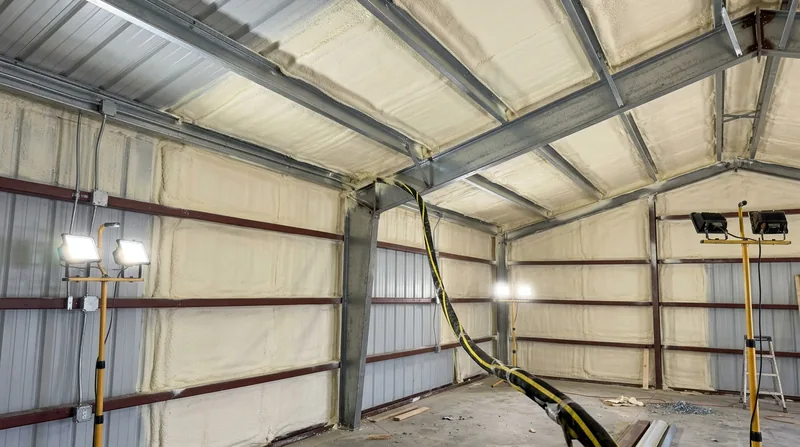




Metal building and barndominium spray foam insulation in Green Bay stops the condensation sweat that coats steel walls and roof decks every winter. Across Brown County, from the tightly packed homes along the Fox River in downtown Green Bay to the newer barndominiums spreading through Howard and Bellevue, metal structures face the same problem: warm indoor air meets cold steel skin, moisture condenses, and the building envelope fails. Closed cell foam sprayed to the interior creates an air barrier and a thermal break that eliminates that moisture problem and holds heat inside during the long heating season. We have been installing spray foam insulation since 2010, and we understand the specific demands of metal buildings in IECC climate zone 6A. A free written estimate with R-value and thickness specifications is the starting point.
Why Metal Building and Barndominium Spray Foam Matters in Greater Green Bay
Metal buildings and barndominiums in Green Bay, Ashwaubenon, Bellevue, and across Brown County experience a failure mode that fiberglass and cellulose cannot fix: condensation on the interior steel skin. The long Wisconsin heating season drives warm, moist interior air outward through any gap or thermal bridge. When that air reaches the cold metal exterior, it condenses into liquid water that pools on horizontal surfaces, drips onto stored goods or equipment, and eventually rots the structure from inside. Closed cell spray foam solves this by creating a continuous air barrier and insulation layer right against the steel, so the metal stays warm enough that condensation never forms.
- Eliminates condensation by raising the interior surface temperature of the steel above the dew point.
- Creates a monolithic air barrier that stops infiltration and exfiltration at every corner and seam.
- Provides R-value between 6 and 7 per inch, so a 2-inch application delivers R-12 to R-14 thermal resistance.
- Adheres directly to metal, wood, or concrete, so no mechanical fastening or additional framing is needed.
- Cures in place and requires no maintenance once the re-entry period has passed.
The result is a dry, usable interior space and a building that holds heat efficiently through the coldest months.
Key info: A 40-by-60 metal building in Bellevue or De Pere with uninsulated walls and a bare steel roof deck loses heat continuously in winter. A 2-inch closed cell foam application stops that loss, raises interior wall and ceiling temperatures, and eliminates the condensation that makes the space unusable for storage or living. Wisconsin's building code governs thermal barrier and ignition barrier requirements for spray foam in occupied spaces, so verify the specifics with your local building department before scheduling.
For more detail on how closed cell foam works and its R-value performance, see our closed cell spray foam insulation page.
How We Spray Foam Metal Buildings and Barndominiums in Green Bay
Every metal building spray foam job in Green Bay starts with a site visit and a written estimate that specifies the foam type, R-value target, and thickness per pass. We inspect the substrate for moisture, rust, or contamination that would prevent adhesion, and we address any prep work upfront. Once the estimate is signed, we schedule the spray during a window when the building can be closed for the cure period and mechanical ventilation can run.
- We visit the site to measure the square footage, assess substrate condition, and identify any obstacles or special requirements.
- We provide a written estimate with R-value, thickness per pass, and the number of passes required to meet your target.
- We clean and prepare the substrate so the foam bonds completely and cures without voids.
- We spray the foam in controlled passes, maintaining the manufacturer's specified ratio and drum temperature throughout.
- We ventilate mechanically during cure and enforce a re-entry window of 24 to 48 hours before the space is occupied.
- We inspect the finished foam for coverage and thickness and provide a post-job walkthrough.
The entire process is transparent and documented, so you know exactly what you are getting and when the space will be ready for use.
Example: A 3,000-square-foot pole barn in Howard scheduled for conversion to a workshop and equipment storage needed condensation control and R-15 thermal value. We applied 2.5 inches of closed cell foam to the roof deck and 2 inches to the sidewalls, bringing the interior surfaces above the dew point and delivering the thermal resistance needed. Mechanical ventilation ran for 36 hours, and the space was occupied the next day. The owner reported no condensation on the steel, even during the coldest weeks of January and February.
For details on air sealing and how foam stops infiltration, see our air sealing page.
| Approach | Description | Best for |
|---|---|---|
| Closed Cell, 2-inch | R-12 to R-14 thermal value, complete air barrier, moisture control on steel. | Metal buildings, barndominiums, pole barns where condensation is the primary problem. |
| Closed Cell, 2.5 to 3-inch | R-15 to R-21 thermal value, superior moisture and air barrier, structural contribution. | Large metal buildings, barndominiums in active use, spaces requiring higher thermal resistance. |
| Closed Cell, 4-inch or greater | R-28 or higher thermal value, maximum structural contribution, full-service thermal and moisture envelope. | Climate-controlled metal buildings, barndominiums used as year-round residences, retrofit of severely underinsulated structures. |
| Foam over Existing Insulation | Closed cell foam applied over sound fiberglass or mineral wool, creating a continuous air barrier and thermal break. | Metal buildings with old batts or blankets that have settled or failed, when a top-up is more economical than full removal. |
Metal Building and Barndominium Spray Foam Cost in Green Bay: What to Expect
Spray foam insulation for metal buildings and barndominiums in Green Bay typically starts at $1.75 per square foot for a 2-inch closed cell application on a straightforward roof deck or wall, and ranges up to $3.50 per square foot or higher for 4-inch or thicker applications, complex geometries, or jobs requiring substrate prep and removal of existing insulation. The size of the building, the height of the roof deck, the condition of the substrate, and the target R-value all affect the final price. For a 3,000-square-foot metal building, pricing typically starts around $1.75 per square foot for the roof deck, before any wall work, and is confirmed on site. Getting 2 or 3 written estimates with R-value and thickness specifications is the only way to compare apples to apples and understand what drives the cost in your specific case.
- Building square footage is the primary cost driver because it determines the volume of foam material and labor time.
- Thickness per pass and the number of passes affect both material cost and application time.
- Substrate condition, rust, or contamination may require cleaning or repair before foam can be sprayed.
- Existing insulation removal, if needed, is a separate line item and adds labor and disposal cost.
- Roof deck height and access, including the need for lifts or scaffolding, can increase labor cost.
- Mechanical ventilation during cure and re-entry time windows are included in the estimate.
The most honest way to understand cost is to call for a free written estimate with specific R-value and thickness details. See our pricing page for a full breakdown of typical costs and what moves them.
What to Look for When Hiring a Spray Foam Insulation Contractor Near Green Bay
The spray foam market includes rig-and-run crews from out of state who spray a job in an afternoon and leave, plus national franchises with high overhead, and local independent shops. The differentiator is not the name on the truck but the quality of the estimate, the transparency of the process, and the ability to reach someone when questions arise after the job is done. When evaluating any spray foam contractor near Green Bay, verify that they provide a written estimate with R-value and thickness specifications, that they carry liability insurance and can provide a certificate on request, and that they understand the local building code requirements for thermal and ignition barriers in occupied spaces. Check references from recent jobs in your area, and ask how they handle substrate prep, mechanical ventilation during cure, and the re-entry period.
- Request a written estimate that specifies foam type, R-value target, thickness per pass, number of passes, and total square footage.
- Verify that the contractor carries full liability insurance and can provide a current certificate of insurance.
- Ask how they prepare the substrate and whether they will walk away if moisture, rust, or contamination prevents proper adhesion.
- Confirm that they use mechanical ventilation during cure and enforce a re-entry window of 24 to 48 hours.
- Get at least two other estimates from contractors with similar experience and local references.
- Ask whether the local building department requires a permit for spray foam in your specific building type and location.
The best contractors answer questions directly, provide detailed estimates, and are reachable after the job is done. Contact us for a free estimate and to discuss your metal building or barndominium insulation needs. Call (920) 247-2669 or visit our contact page to schedule a site visit.
Metal Building & Barndominium Spray Foam in Green Bay: Pricing Guide
| Service | Price | Details |
|---|---|---|
| Closed Cell Foam, 2-inch application | Starting at $1.75/sq ft | R-12 to R-14 thermal value, condensation control on metal, includes prep and mechanical ventilation during cure |
| Closed Cell Foam, 2.5 to 3-inch application | Starting at $2.25/sq ft | R-15 to R-21 thermal value, enhanced moisture and air barrier, substrate prep and mechanical ventilation included |
| Closed Cell Foam, 4-inch or greater | Starting at $3.00/sq ft | R-28 or higher, maximum thermal and structural performance, thickness and substrate condition determine final cost |
| Existing insulation removal and disposal | On estimate | Cost depends on square footage, insulation type, and accessibility; required before new foam application in many cases |
| Travel and site visit | Included | Free estimate visit within Green Bay and surrounding service areas, no mileage charge or call-out fee |
| Written estimate with R-value and thickness | Free | Detailed specification of foam type, application rate, and thermal performance, no obligation to book |
Indicative pricing, the exact cost depends on square footage, finish, and site access. Free personalized estimate within 24h at (920) 247-2669.


