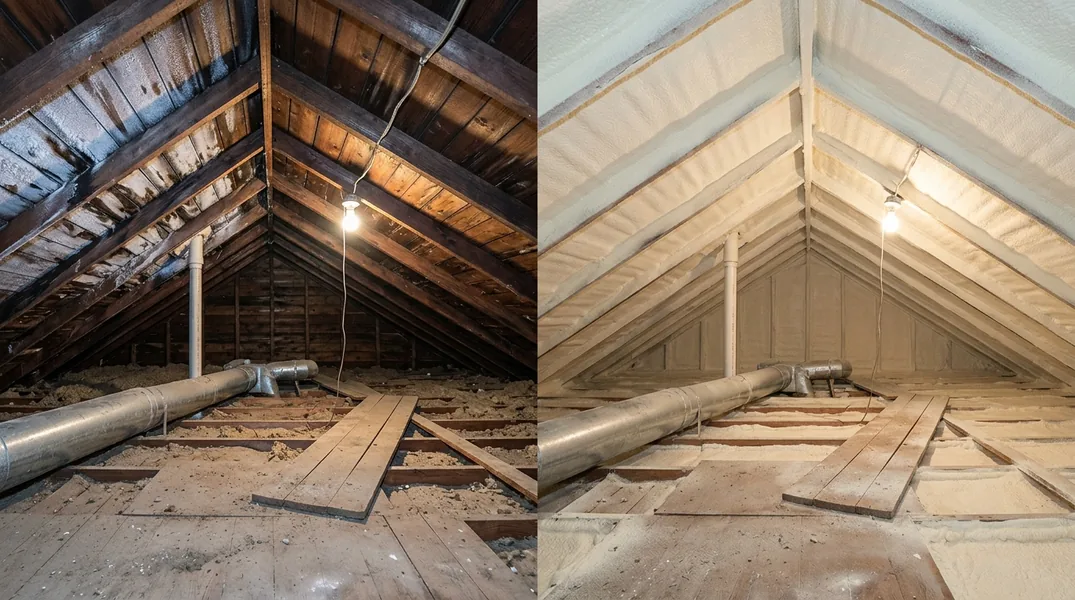
Understanding Spray Foam R-Value and Wisconsin Requirements
When homeowners in Green Bay think about upgrading their attic insulation, one of the first questions is about R-value. The R-value measures thermal resistance, and higher numbers mean better insulation performance. For Attic Spray Foam Insulation, the R-value per inch varies depending on the type of foam used.
Closed Cell Spray Foam Insulation delivers approximately 6.0 to 6.5 R-value per inch, making it one of the most efficient insulation materials available. Open Cell Spray Foam Insulation, on the other hand, provides around 3.5 to 3.6 R-value per inch. Wisconsin's energy code generally recommends an R-value of R-49 to R-60 for attic insulation in our climate zone, depending on your specific location and the age of your home. Understanding these numbers helps you decide whether topping up your existing insulation or doing a complete spray foam installation makes the most financial and practical sense.
Air Sealing as a Strategic First Step
Before diving into a full Attic Spray Foam Insulation project, many homeowners benefit from strategic air sealing. Air leaks are one of the biggest energy wasters in older homes, and Green Bay homes built decades ago are particularly prone to these gaps. Air sealing involves identifying and closing off penetrations where air can escape, such as around electrical outlets, ductwork, plumbing vents, and the rim joist area where your walls meet the foundation.
The beauty of air sealing is that it's often less expensive than a full spray foam installation and can deliver immediate energy savings. If your existing insulation is still in decent condition and provides adequate R-value coverage, a focused air sealing approach combined with selective insulation top-ups might be all you need. This strategy is particularly effective if your energy bills have risen recently due to drafts rather than insufficient insulation depth. Many homeowners see 10 to 15 percent energy savings just from professional air sealing, making it a smart entry point before committing to larger projects.
When Full Spray Foam Installation Makes More Sense
There are situations where air sealing alone falls short, and a complete Attic Spray Foam Insulation project becomes the better investment. If your attic insulation is old, compressed, or significantly below the R-49 to R-60 range recommended for Wisconsin, you're losing money every heating season. Compressed fiberglass batts or cellulose that has settled over time no longer provide their rated R-value, and replacing them with spray foam eliminates that problem permanently.
Another compelling reason to go full spray foam is moisture control. Closed Cell Spray Foam Insulation acts as both an air barrier and a vapor barrier, protecting your attic from Wisconsin's seasonal humidity swings and preventing mold growth. If your current insulation shows signs of moisture damage, pest intrusion, or deterioration, partial solutions won't cut it. Additionally, spray foam provides superior structural support and can help reduce noise transmission from outside. For homeowners planning to stay in their Green Bay home long-term, the durability and performance of spray foam often justify the higher upfront cost through decades of reliable performance.
How Thick Should Spray Foam Be for Optimal Performance
The question of thickness directly ties to your R-value targets and budget. As mentioned earlier, closed cell foam delivers about 6.0 to 6.5 R-value per inch, while open cell provides roughly 3.5 to 3.6 R-value per inch. To hit Wisconsin's recommended R-49, you would need approximately 7.5 to 8 inches of closed cell foam or roughly 14 inches of open cell foam. To reach the higher R-60 standard, closed cell would require about 9 to 10 inches, while open cell would need closer to 17 inches.
The choice between closed and open cell affects not just the thickness needed but also the cost and application method. Closed cell foam is denser, more expensive, but requires less thickness for the same R-value. Open cell is lighter, less costly per board foot, but demands more space to achieve equivalent insulation. In attics with limited headroom or where you want to preserve access to roof framing, closed cell's superior R-value per inch becomes especially valuable. A professional assessment from Green Bay Spray Foam Insulation can help you determine the optimal thickness for your specific attic layout and energy goals.
Tax Credits and Rebates for Insulation Upgrades in Wisconsin
One often overlooked advantage of upgrading your home's insulation is access to federal tax incentives. The federal insulation tax credit allows homeowners to claim up to 30 percent of the cost of qualifying insulation improvements, capped at $3,200 total for all energy efficiency credits combined. This applies to both spray foam and traditional insulation materials, making it a meaningful reduction in your out-of-pocket expense. To qualify, the insulation must meet specific energy performance standards and be installed in your primary residence.
Beyond federal credits, Wisconsin and local utilities often offer insulation rebates to encourage energy-efficient upgrades. Programs vary by utility provider and change annually, so it's worth contacting your local electric or gas company to ask about current offerings. Some programs rebate a percentage of insulation costs, while others provide flat amounts per square foot of coverage. When you contact Green Bay Spray Foam Insulation for a free estimate, our team can help you understand which incentives apply to your project and ensure your installation qualifies. These credits and rebates can significantly reduce the effective cost of your insulation investment, sometimes making full spray foam installation more affordable than you initially expected.
Attic Spray Foam Insulation Cost in Green Bay: What to Budget
Understanding pricing helps you make an informed decision between air sealing top-ups and full spray foam installation. Air sealing projects typically range from $500 to $2,000 depending on the extent of work needed and the size of your attic. Partial insulation top-ups with spray foam or traditional materials might run $1,500 to $4,000 for a typical Green Bay home. A complete attic spray foam installation, removing old insulation and applying new closed or open cell foam, generally ranges from $4,000 to $10,000 or more, depending on attic size and foam type.
While full spray foam costs more upfront, the return on investment is substantial. Most homeowners recover their investment through energy savings within 5 to 10 years, and the insulation will continue performing for 30 to 80 years depending on the material. Factor in the tax credits and rebates mentioned above, and your net cost drops considerably. The best way to understand your specific situation is to request a detailed quote from Green Bay Spray Foam Insulation. Call us at (920) 247-2669 or visit our website to schedule your free estimate, and we'll assess your current insulation, discuss your energy goals, and present both air sealing and full installation options with transparent pricing.
Looking for a professional spray foam insulation contractor in Green Bay? Green Bay Spray Foam Insulation responds fast for all your spray foam insulation needs.
Get a Free Quote