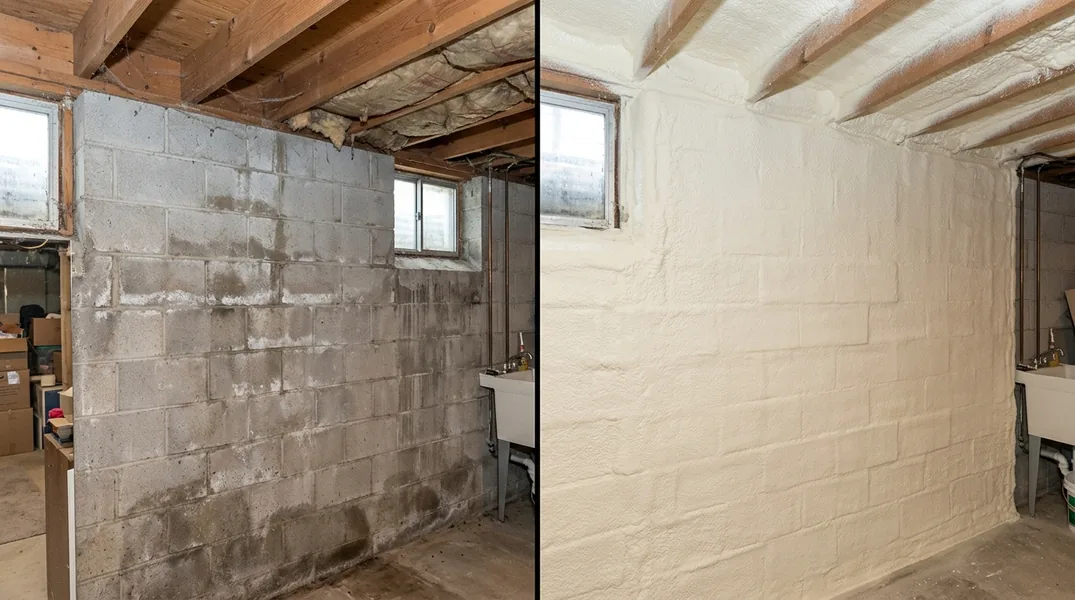
Understanding Spray Foam Attic Insulation: Open Cell vs. Closed Cell
When it comes to upgrading your home's energy efficiency, attic spray foam insulation has become one of the most popular choices for homeowners in Green Bay. Both open cell and closed cell spray foam offer significant advantages over traditional fiberglass or cellulose insulation, but they work in different ways and come with distinct benefits and drawbacks. Understanding the differences between these two options is essential for making an informed decision that will serve your home well for decades to come.
The fundamental distinction between open cell and closed cell spray foam lies in their cellular structure. Open cell foam has cells that are not completely enclosed, allowing air and moisture to pass through the material. Closed cell foam, on the other hand, features cells that are completely sealed, creating a barrier that prevents air and moisture infiltration. This structural difference affects everything from the insulation's R-value to its moisture resistance and cost, making it crucial for homeowners to understand which option aligns with their specific needs.
What is Open Cell Spray Foam Insulation?
Open Cell Spray Foam Insulation is a lighter, more flexible material that expands significantly after application. Because the cells remain open, this foam is permeable to air and moisture, which means it allows water vapor to pass through it. This characteristic makes open cell foam an excellent choice for applications where breathability is important, and it's often preferred for interior applications where moisture management is less of a concern.
One of the primary advantages of open cell foam is its lower cost compared to closed cell alternatives. For homeowners in Ashwaubenon and surrounding areas looking to improve their attic insulation on a budget, open cell foam can provide an R-value of approximately 3.5 to 3.6 per inch. While this is lower than closed cell foam, it still offers excellent thermal performance. Additionally, open cell foam provides superior sound dampening qualities, making it an attractive option for homeowners concerned about noise reduction. The material is also less dense, which means it requires less material to fill a given space, contributing to its cost-effectiveness.
However, open cell foam does have limitations. Because it's permeable to moisture, it's not ideal for areas prone to water intrusion or for creating a vapor barrier. In regions with high humidity or where moisture control is critical, open cell foam may allow condensation to develop within the insulation layer. This is an important consideration for attic applications, particularly in climates where temperature fluctuations are common.
Exploring Closed Cell Spray Foam Insulation Benefits
Closed Cell Spray Foam Insulation is a denser, more rigid material that provides superior moisture resistance and a higher R-value. Because the cells are completely sealed, this foam creates an effective vapor barrier that prevents moisture and air from passing through. For homeowners seeking maximum protection and energy efficiency, closed cell foam is often the preferred choice, especially in attics where moisture control and air sealing are priorities.
The primary advantage of closed cell foam is its exceptional R-value, which typically ranges from 6.0 to 7.0 per inch. This means you need less material to achieve the same insulation performance compared to open cell foam, making it highly efficient for attic applications. Additionally, closed cell foam provides outstanding air sealing properties, effectively eliminating drafts and preventing air leakage. This superior performance translates directly into lower energy bills and improved home comfort. The material is also resistant to moisture and can help prevent mold growth, making it ideal for creating a sealed attic insulation system that protects your home from the elements.
The trade-off with closed cell foam is its higher cost. Because it requires more material and specialized application techniques, the price per square foot is typically 40 to 50 percent higher than open cell foam. However, for many homeowners, the superior performance and long-term energy savings justify the initial investment. Closed cell foam also adds structural rigidity to your attic, which can be beneficial in areas prone to high winds or severe weather.
Unvented Attic Spray Foam: Creating an Energy-Efficient Sealed Space
One of the most significant advantages of spray foam insulation is the ability to create an unvented attic spray foam system. Traditional attic ventilation relies on soffit and ridge vents to allow air circulation, which can lead to heat loss in winter and moisture buildup. By applying spray foam directly to the underside of the roof deck and the attic walls, you create a sealed, conditioned space that functions as part of your home's thermal envelope.
This approach offers numerous benefits for homeowners in Bellevue and throughout the Green Bay area. First, it eliminates the temperature differential between your attic and living spaces, reducing the workload on your HVAC system and lowering energy costs. Second, it prevents moisture from accumulating in your attic, which can lead to mold growth, wood rot, and structural damage. Third, it creates a more comfortable home by eliminating drafts and cold spots that are common in traditionally vented attics.
Converting to an unvented attic system requires careful planning and proper installation. The spray foam must be applied to create an air-tight seal, and the system must be designed to prevent moisture buildup. This is where working with experienced professionals becomes essential. Green Bay Spray Foam Insulation has the expertise to design and install unvented attic systems that meet local building codes and provide optimal performance for your specific home.
Attic Spray Foam Insulation Cost in Green Bay: What to Budget
Understanding the cost structure of spray foam insulation is essential for planning your home improvement budget. The pricing for attic spray foam insulation varies based on several factors, including the type of foam you choose, the size of your attic, the complexity of the installation, and your home's specific requirements.
Open cell foam typically costs between $0.40 and $0.65 per board foot, while closed cell foam generally ranges from $0.75 to $1.50 per board foot. For a typical attic project in Green Bay, homeowners can expect to invest anywhere from $2,000 to $8,000, depending on their attic size and the foam type selected. While this may seem like a significant upfront investment, it's important to consider the long-term savings. Many homeowners recoup their investment within 5 to 10 years through reduced heating and cooling costs.
Several factors influence the final cost of your project. The condition of your existing insulation, the presence of air leaks, the complexity of your attic layout, and whether you need additional work like mold remediation or ventilation modifications all affect pricing. The best way to understand your specific costs is to request a free estimate from Green Bay Spray Foam Insulation. Our team can assess your attic, answer your questions, and provide a detailed quote that reflects your home's unique needs and your budget considerations.
Choosing the Right Foam Type for Your Green Bay Home
Deciding between open cell and closed cell spray foam ultimately depends on your specific situation, priorities, and budget. Both materials offer excellent insulation performance, but they excel in different scenarios. Open cell foam is ideal if you're looking for a cost-effective solution with good sound dampening properties and your attic doesn't have significant moisture concerns. Closed cell foam is the better choice if you want maximum energy efficiency, superior moisture protection, and are willing to invest more upfront for long-term performance.
Consider your home's location, climate, existing moisture issues, and long-term plans. Homes in the Green Bay area experience cold winters and occasional humidity challenges, which means moisture control is an important consideration. If your attic has had any history of moisture problems or if you're concerned about future humidity issues, closed cell foam's superior vapor barrier properties may be worth the additional cost. Conversely, if your attic is dry and well-maintained, open cell foam can provide excellent performance at a lower price point.
The best decision is one made with professional guidance. When you contact Green Bay Spray Foam Insulation at (920) 247-2669, our experienced team can evaluate your attic, discuss your concerns, and recommend the most appropriate solution for your home. We'll help you understand the pros and cons of each option, explain how they'll perform in your specific situation, and provide transparent pricing so you can make an informed decision with confidence.
Looking for a professional spray foam insulation contractor in Green Bay? Green Bay Spray Foam Insulation responds fast for all your spray foam insulation needs.
Get a Free Quote